The Art of Mukaish and Kaamdani: Reviving Traditional Metallic Embellishments
HERITAGE TEXTILES • BAHAWALPUR FOCUS • BRIDAL COUTURE
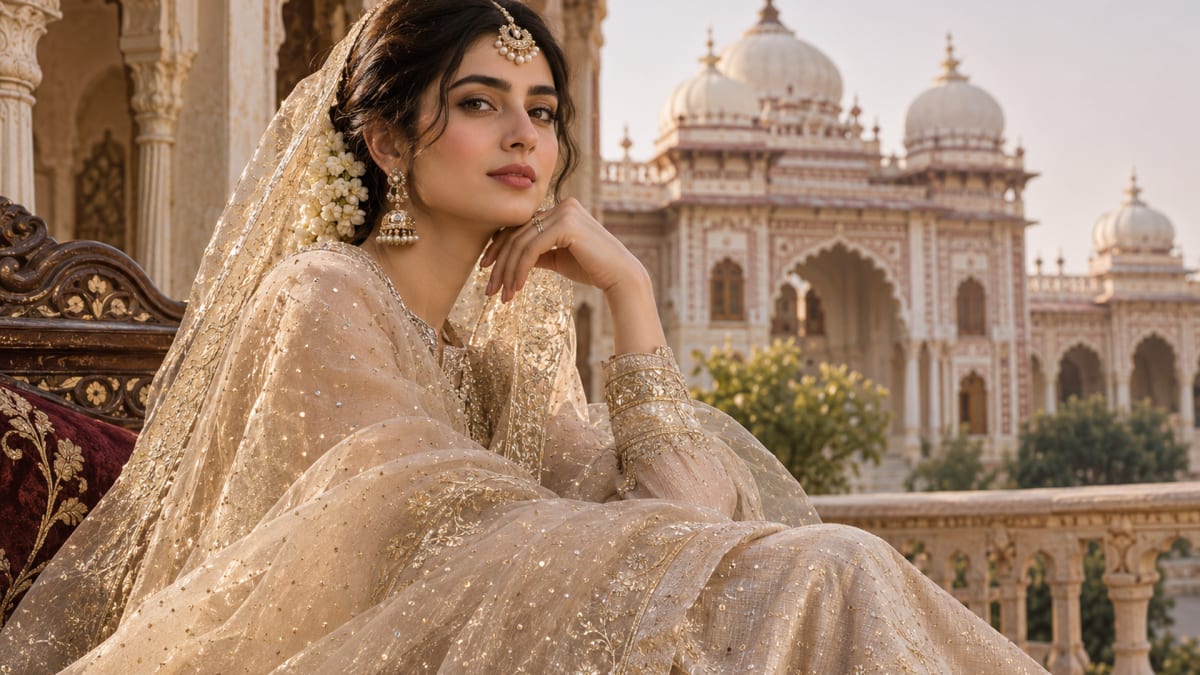
A closer look at Bahawalpur’s Mukesh heritage, the artisans behind the shimmer, and its place in modern Pakistani couture
A couture interpretation of Mukaish and Kaamdani’s luminous appeal · AI-generated illustration
The glow that begins with a single stitch
Imagine a dupatta that catches the light with every movement—not because it is covered in crystals, but because its surface carries hundreds of tiny, carefully placed points of metal. The shimmer is restrained, almost secretive, until the fabric turns and begins to glow. This is the enchantment of Mukaish, also spelled Mukesh, and the more elaborate patterns known as Kaamdani.
Across South Asia, these forms of hand embellishment have brought a distinctive sparkle to delicate textiles. For lovers of Pakistani bridal wear, they offer an alternative to heavy embellishment: a way to look luminous without losing the softness, movement, and beauty of the fabric itself.
Why Bahawalpur deserves a place in this story
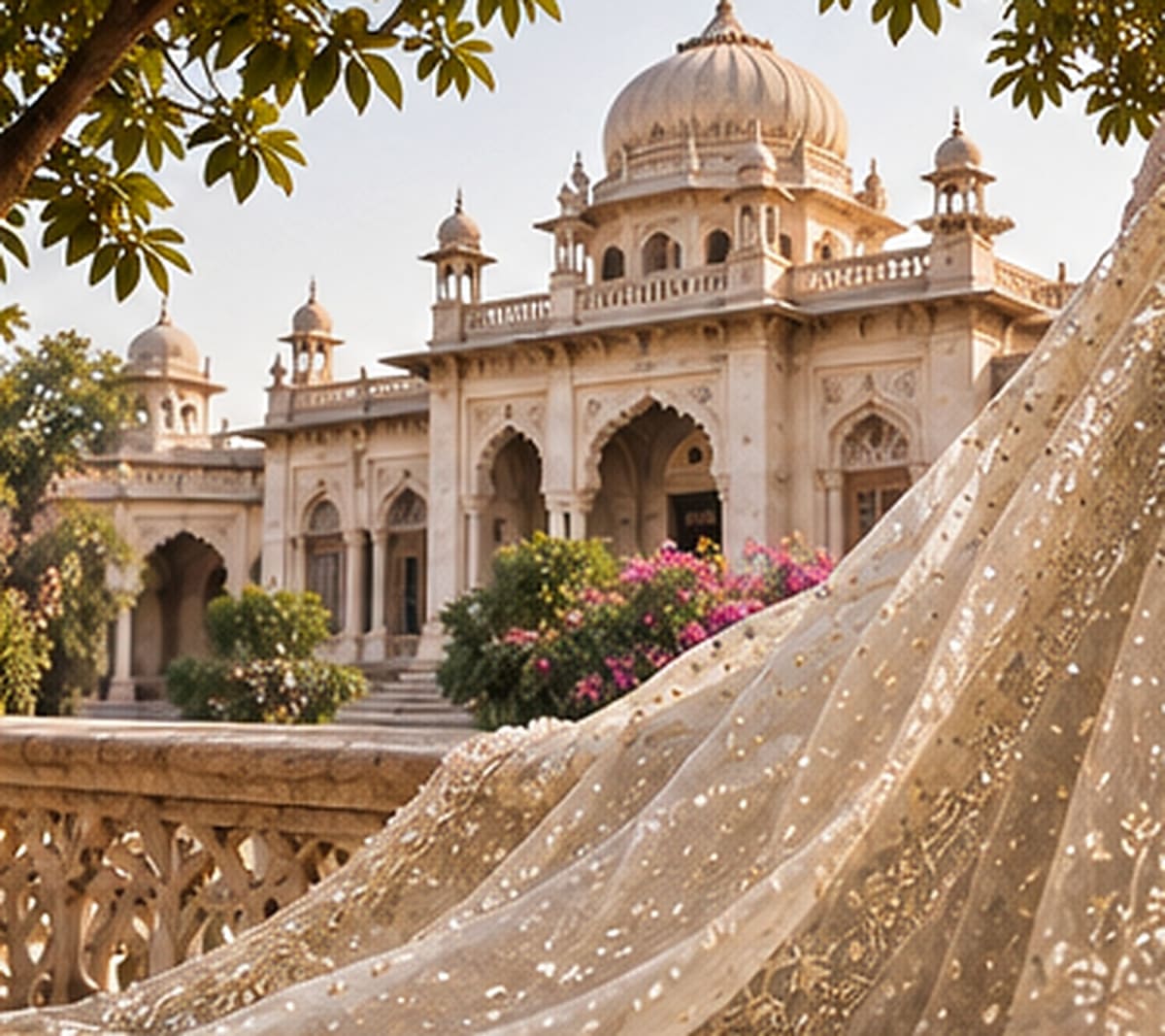
Bahawalpur is celebrated for its craft heritage, from vibrant Cholistan textiles and chunri to intricate embroidery and traditional khussa footwear. Importantly, Mukaish is not merely a modern label attached to the region. Pakistan’s Small and Medium Enterprises Development Authority (SMEDA), in its Handicrafts Cluster profile of Bahawalpur, explicitly lists “mukesh” among local handicraft products. The Punjab Small Industries Corporation also lists “Mukesh Work” among the techniques associated with its Bahawalpur Handicraft Development Centre near Farid Gate.
That local record matters. It places Mukesh within Bahawalpur’s living handicraft economy, much of which has traditionally operated through home-based or small-scale work. The region’s aesthetic—its warm colours, celebratory textiles, delicate details, and heritage of courtly dress—offers beautiful inspiration for today’s designers.
For historical accuracy, however, it is important to distinguish a local craft tradition from the craft’s best-documented historical centre. Mukaish and Kaamdani are especially associated with Lucknow and the wider Awadh tradition. Bahawalpur’s Mukesh heritage is part of this broader South Asian language of metallic embellishment; the available sources do not establish Bahawalpur as the place where the technique originated.
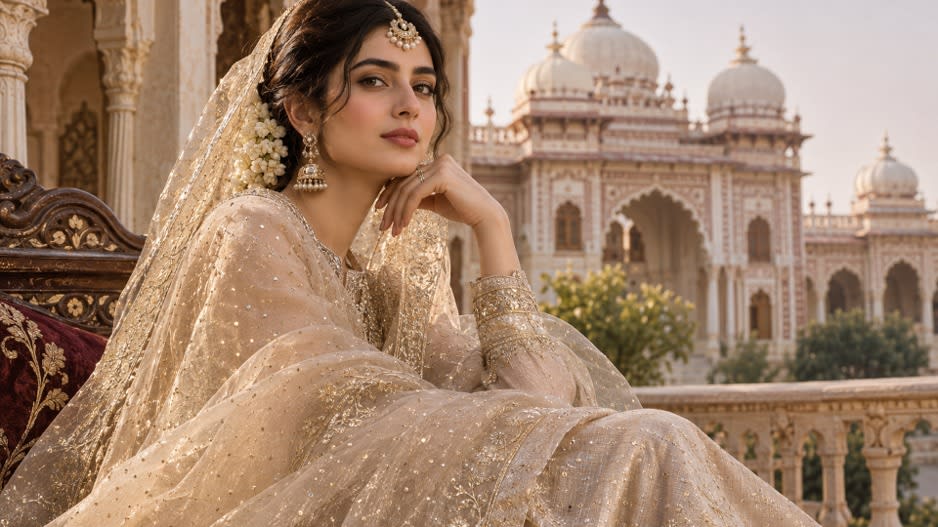
A Bahawalpur-inspired setting evokes the region’s decorative heritage · AI-generated illustration
What is Mukaish embroidery?
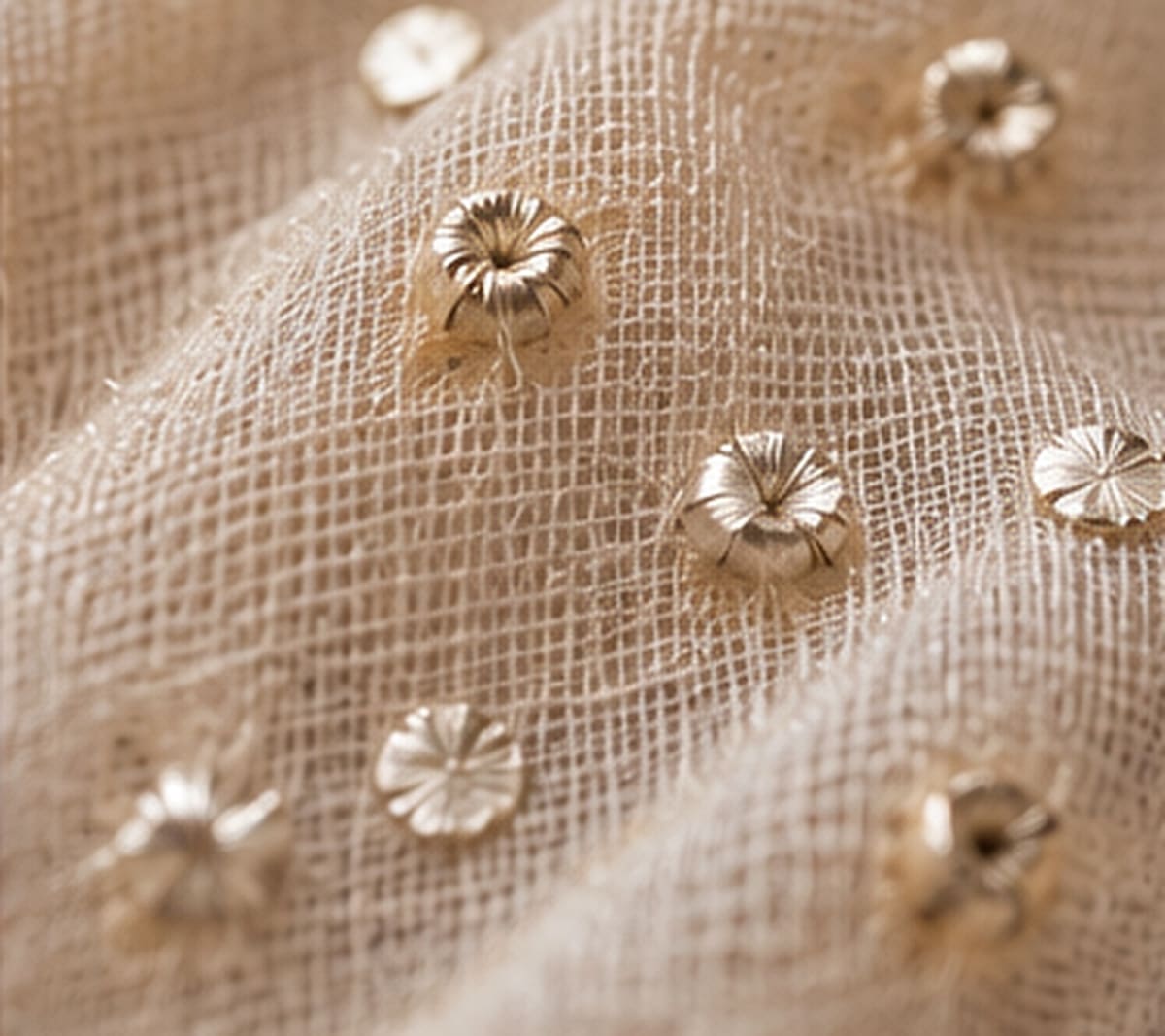
Mukaish is a metallic embroidery technique that uses very fine, flattened metal wire, commonly called badla, to make reflective details on fabric. Instead of attaching large stones or covering the cloth with thick threads, the artisan inserts and manipulates tiny lengths of wire so that they sit as bright points or small shapes on the surface.
Historically, some luxury examples used gold or silver. Today, many makers work with other metal wires or metal-coated alternatives in golden and silvery finishes. The signature effect is not simply “glitter”: it is a controlled sparkle that appears to be part of the textile itself. Sheer organza, muslin, chiffon-like fabrics, georgette, and other fine materials are often chosen because they allow the embellishment to feel airy.
Fardi creates scattered points of reflective metal · AI-generated illustration
Mukaish, Fardi and Kaamdani: understanding the difference
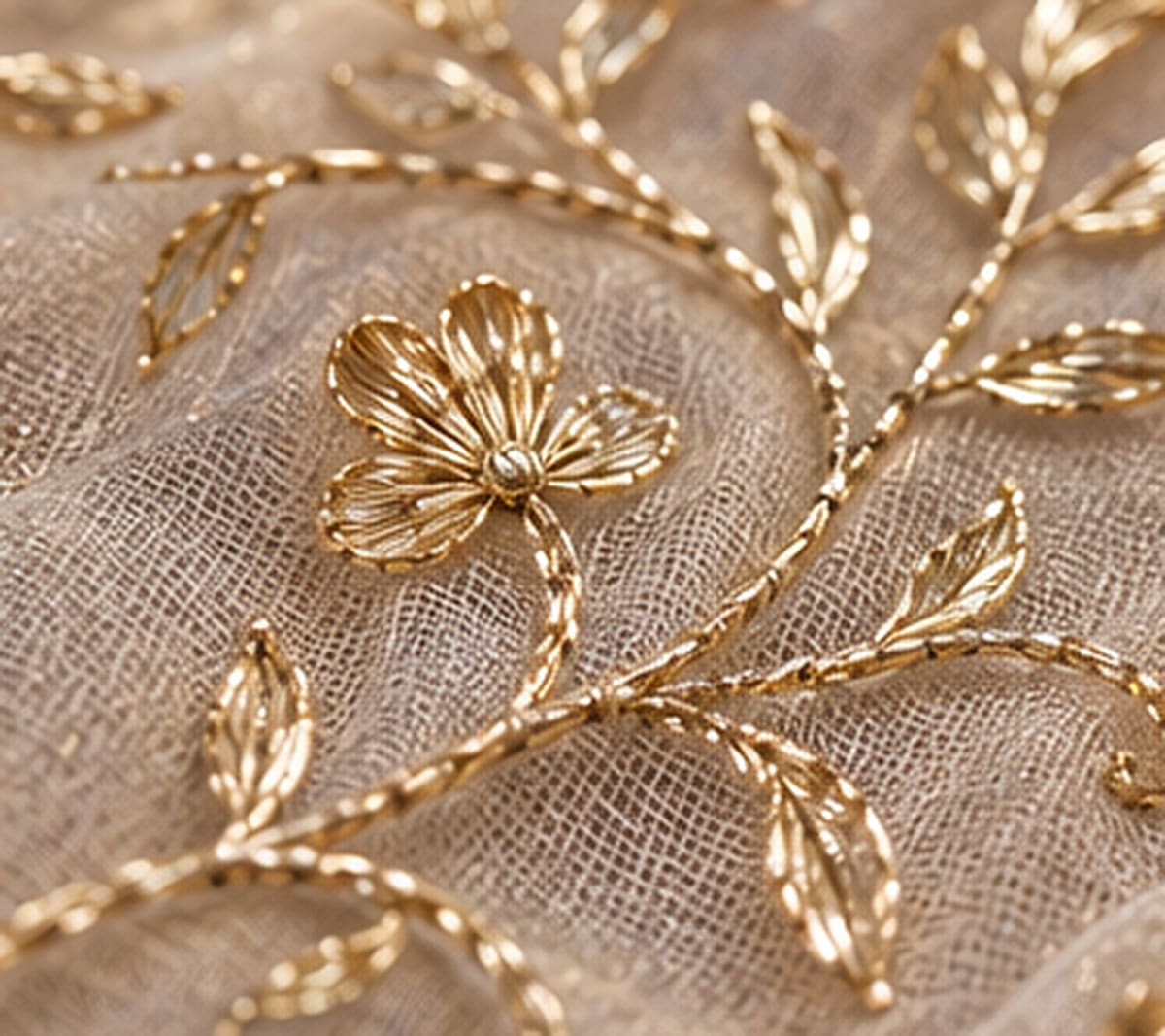
The terminology can be confusing because people sometimes discuss Mukaish and Kaamdani as separate arts. In several craft references, Kaamdani and fardi ka kaam are described as two principal ways of making Mukaish or badla embroidery. Their distinction is easiest to understand by looking at the pattern:
• Fardi ka kaam: tiny individual metallic knots or dots, sometimes arranged as an even scattering across a dupatta. The result can resemble a soft field of stars.
• Kaamdani: the same metallic language developed into more detailed shapes—floral sprays, climbing vines, curved borders, geometric accents, and other motifs.
A bridal dupatta might use scattered fardi dots through the centre and a richer Kaamdani-style border along the edges. The combination feels opulent without becoming overly heavy.
Kaamdani develops metallic accents into floral motifs and vines · AI-generated illustration
The material behind the magic: badla wire
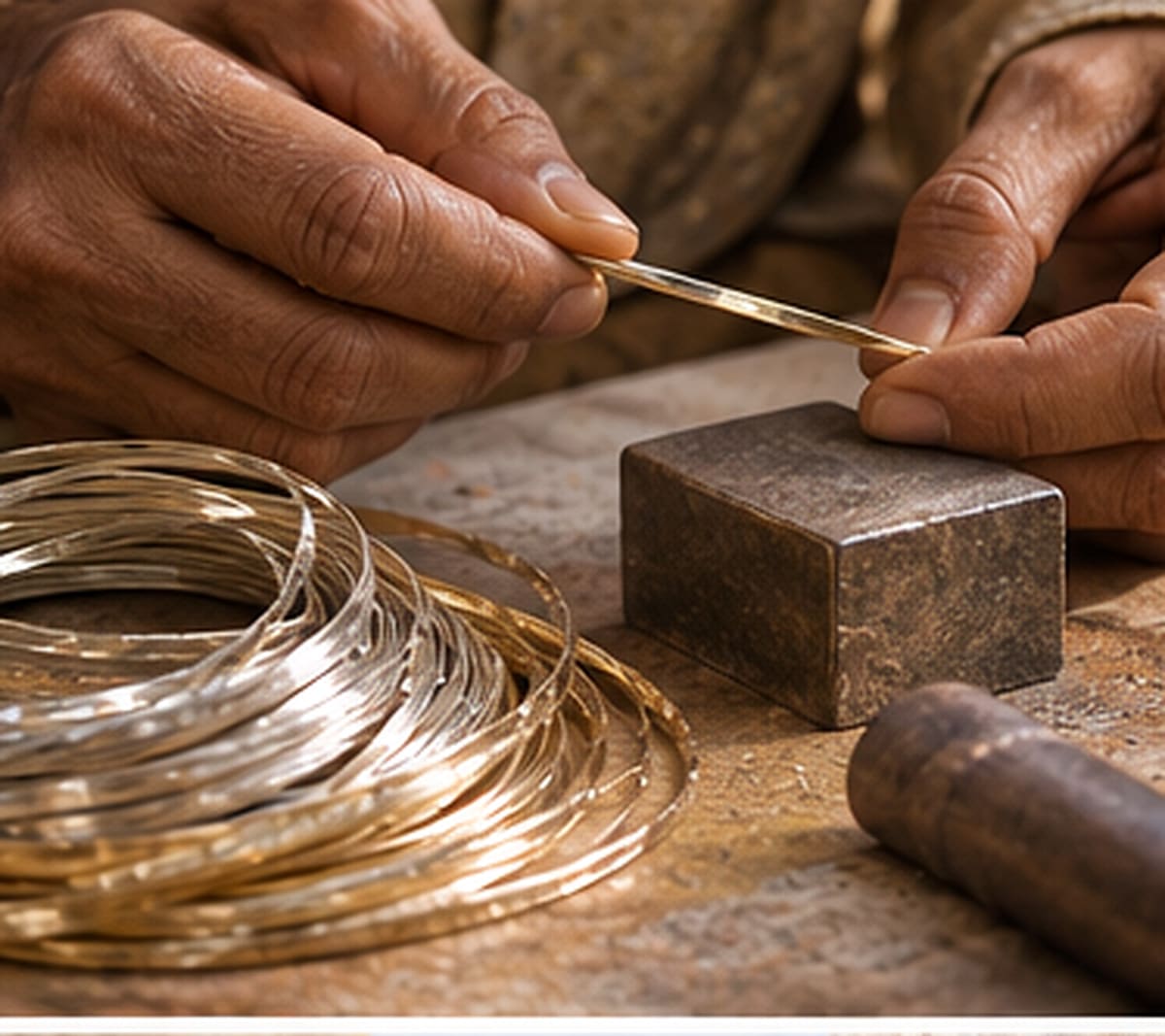
Traditional Mukaish is not made simply by sewing ordinary shiny thread over the surface. Its defining material is badla: thin, flattened metallic wire that can be guided through a textile with considerable care. A maker must balance wire thickness, motif size, fabric delicacy, and the tension of every insertion.
That precision is why a handmade sample deserves a close look. Genuine craft is visible in the regularity of the dots, the security of each detail, and the way the fabric still falls naturally. Depending on the garment, heavier metalwork can be combined with lighter embroidered sections—but the two should be planned together rather than added as an afterthought.
Fine flattened metal wire forms the basis of traditional badla work · AI-generated illustration
Step one: Chapaayi — drawing the design

Before any metallic stitch is placed, the placement must be decided. In the traditional process known as chapaayi, artisans transfer or mark a pattern onto fabric. A carefully considered outline makes all the difference: a scattered-dot field needs even rhythm, while a floral bel, or vine, needs graceful movement.
For couture, the design stage is also where proportion becomes essential. The density of embellishment around a neckline, the width of a sleeve border, and the amount of sparkle across a dupatta can all be customized to complement the bride’s silhouette.
A printed or traced guide helps keep the design balanced · AI-generated illustration
Step two: Takaayi — placing the metal by hand
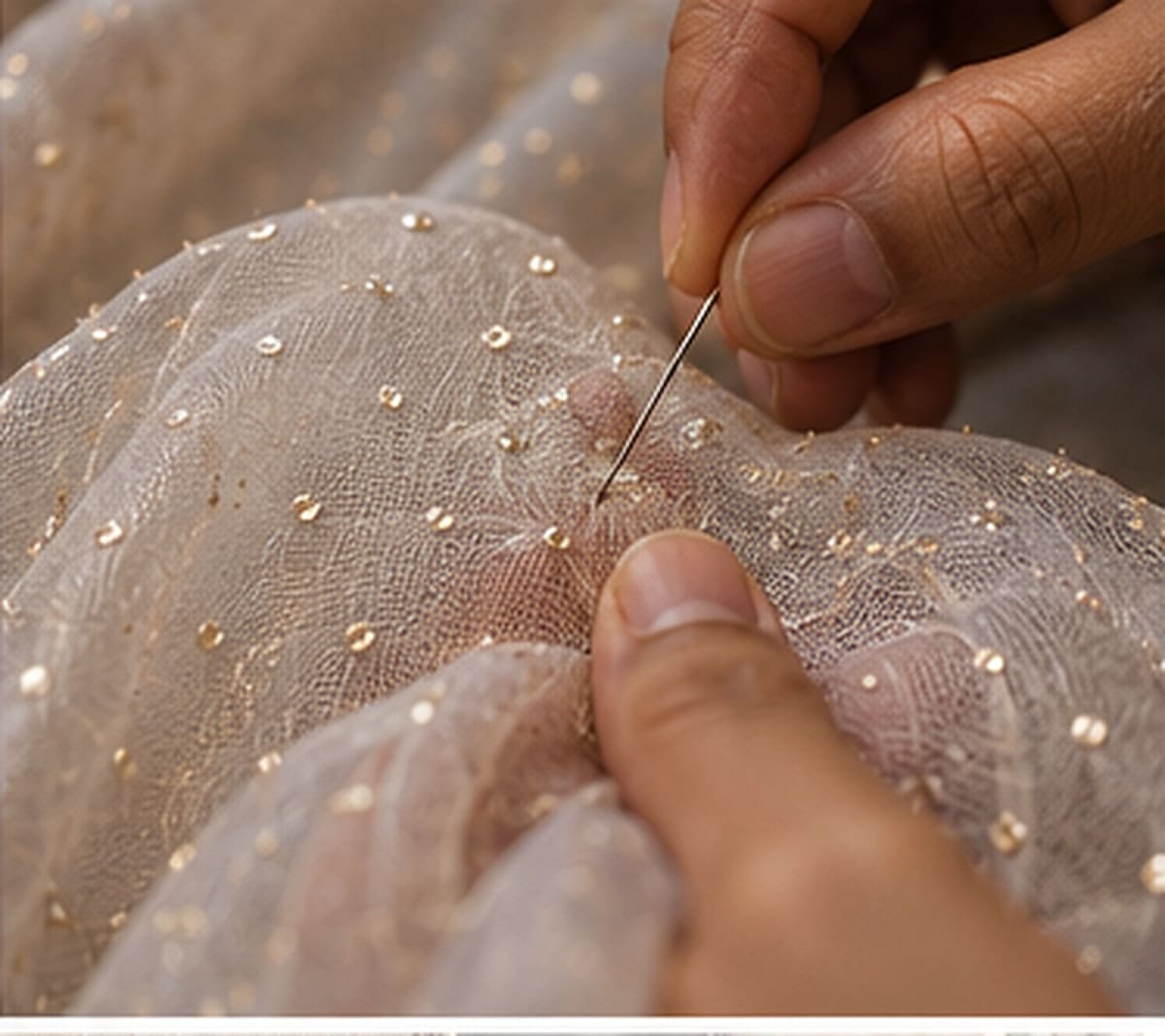
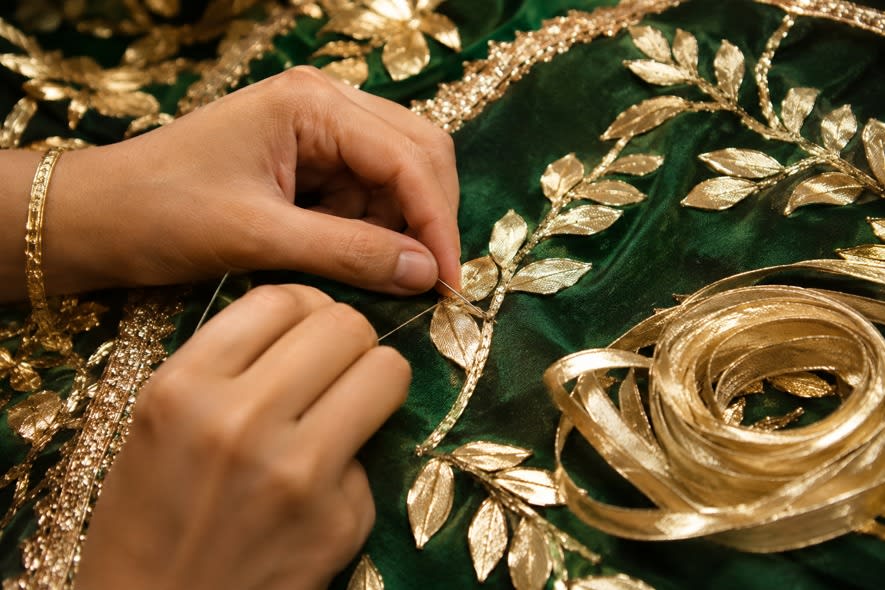
Takaayi is the demanding heart of the work. Using needles and fine wire, the artisan creates tiny metallic details one by one. In fardi work, the effect comes from repeated little points. In Kaamdani, those points become lines and motifs that need a steady hand and a consistent touch.
Because each section is shaped individually, the work cannot be judged only by its finished photograph. The time, concentration, and practiced eye behind the surface are part of its value. On a lightweight fabric, the challenge is even greater: beauty must be added without damaging the material underneath.
Tiny metallic details are applied with a steady hand · AI-generated illustration
Step three: Ghutaayi — revealing the shine
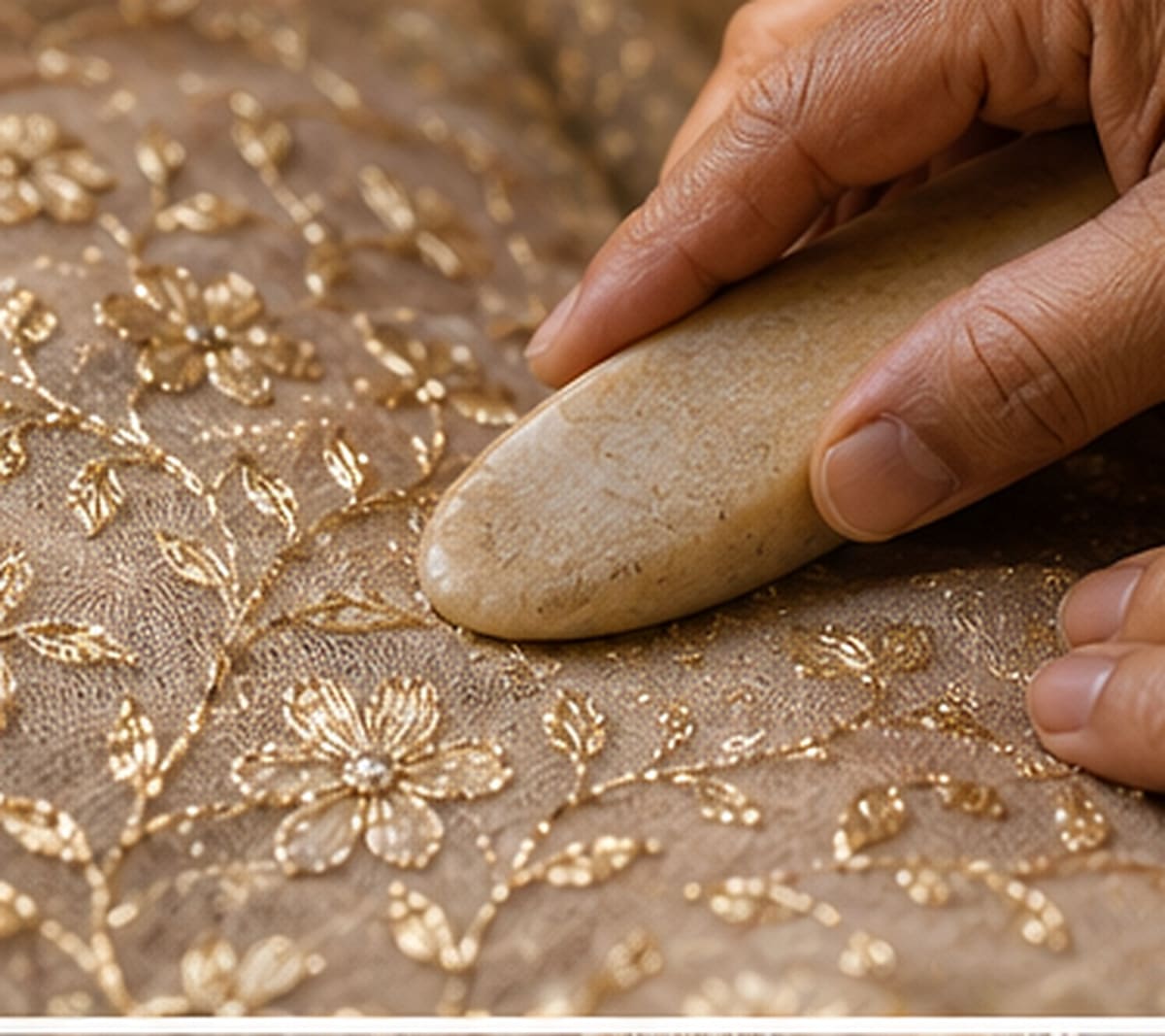
Traditional descriptions of the technique include a finishing stage called ghutaayi, when the metallic work is carefully smoothed and burnished. This helps flatten irregularities and bring out the reflective finish of the wire.
The result should feel refined rather than rough. A well-finished piece responds to changing light, from the calm glow of daylight to the warmer shimmer of an evening wedding. Every finished garment must also be assessed for comfort, snagging risks, and the sensitivity of the underlying fabric.
Traditional burnishing helps bring out the metallic shine · AI-generated illustration
A heritage dupatta that tells its own story
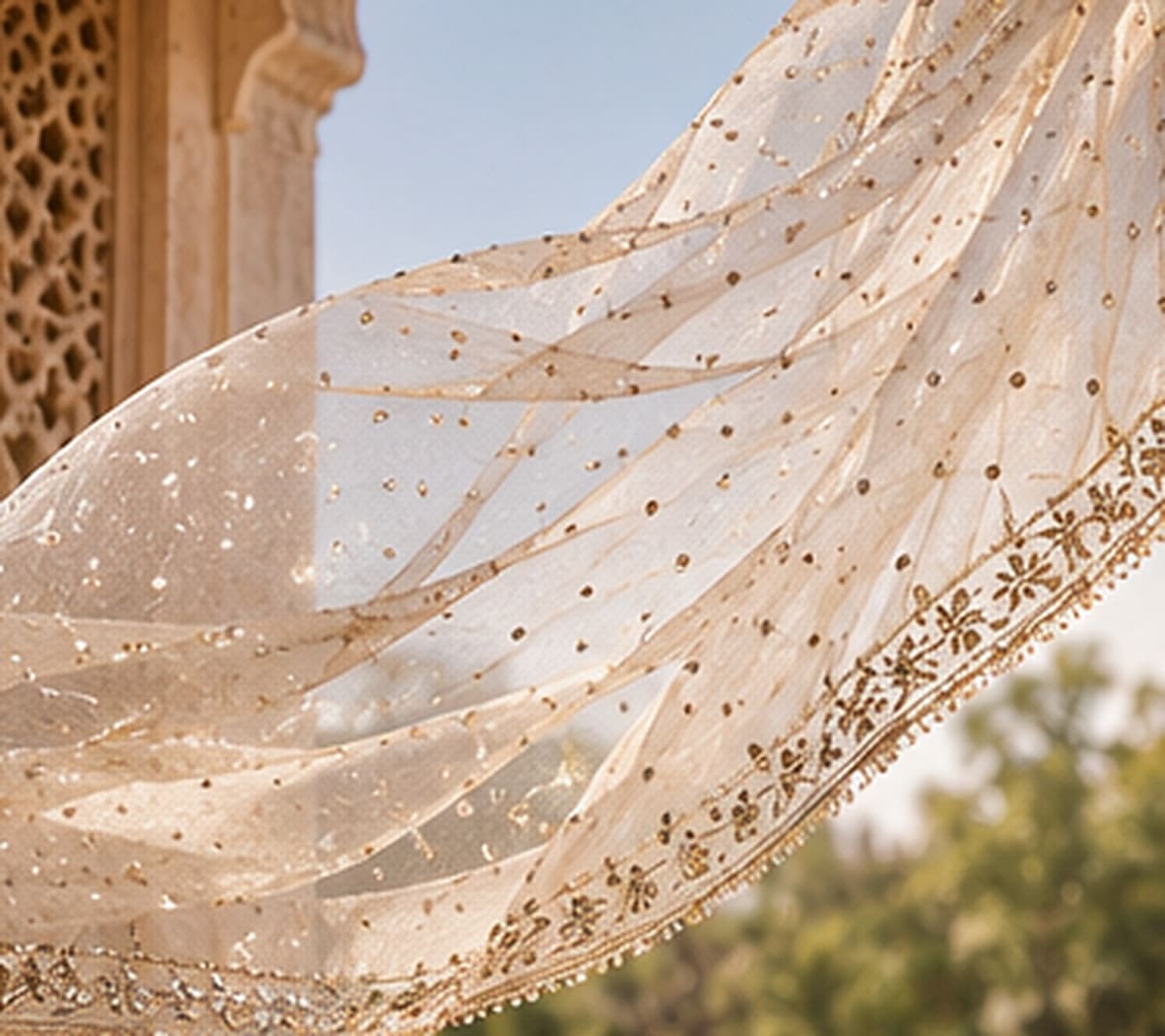
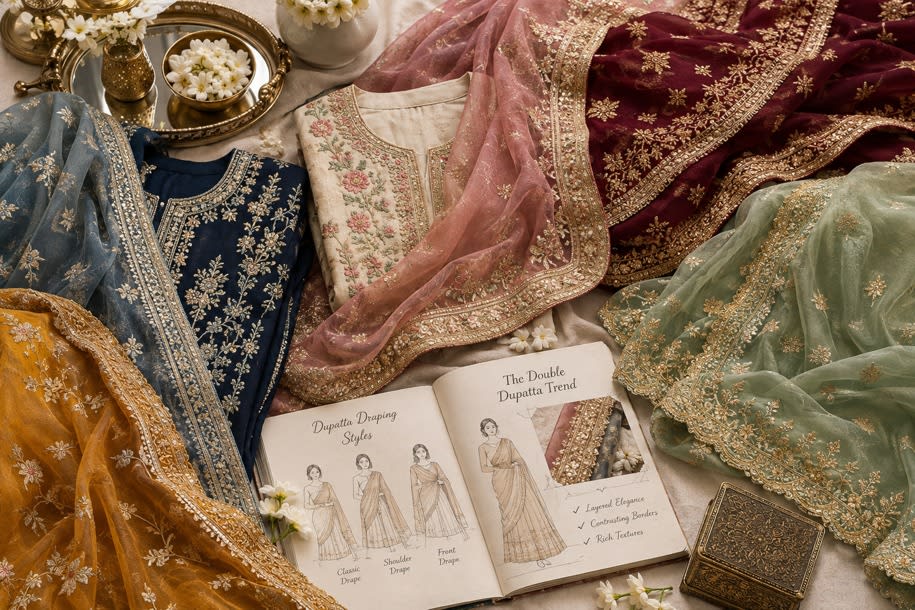
Few accessories show the beauty of Mukaish better than a floating dupatta. The centre can remain light and translucent, scattered with small reflective dots, while the edges carry more expressive Kaamdani florals or an understated metallic border.
For a bride who wants her jewellery, makeup, and face to remain the focus, this balance can be especially striking. A soft ivory or champagne dupatta gives a gentle glow, while warmer tones can echo the richness of Bahawalpur- and Cholistan-inspired wedding palettes.
A light Mukaish-style dupatta combines movement and shimmer · AI-generated illustration
From traditional celebrations to bridal couture
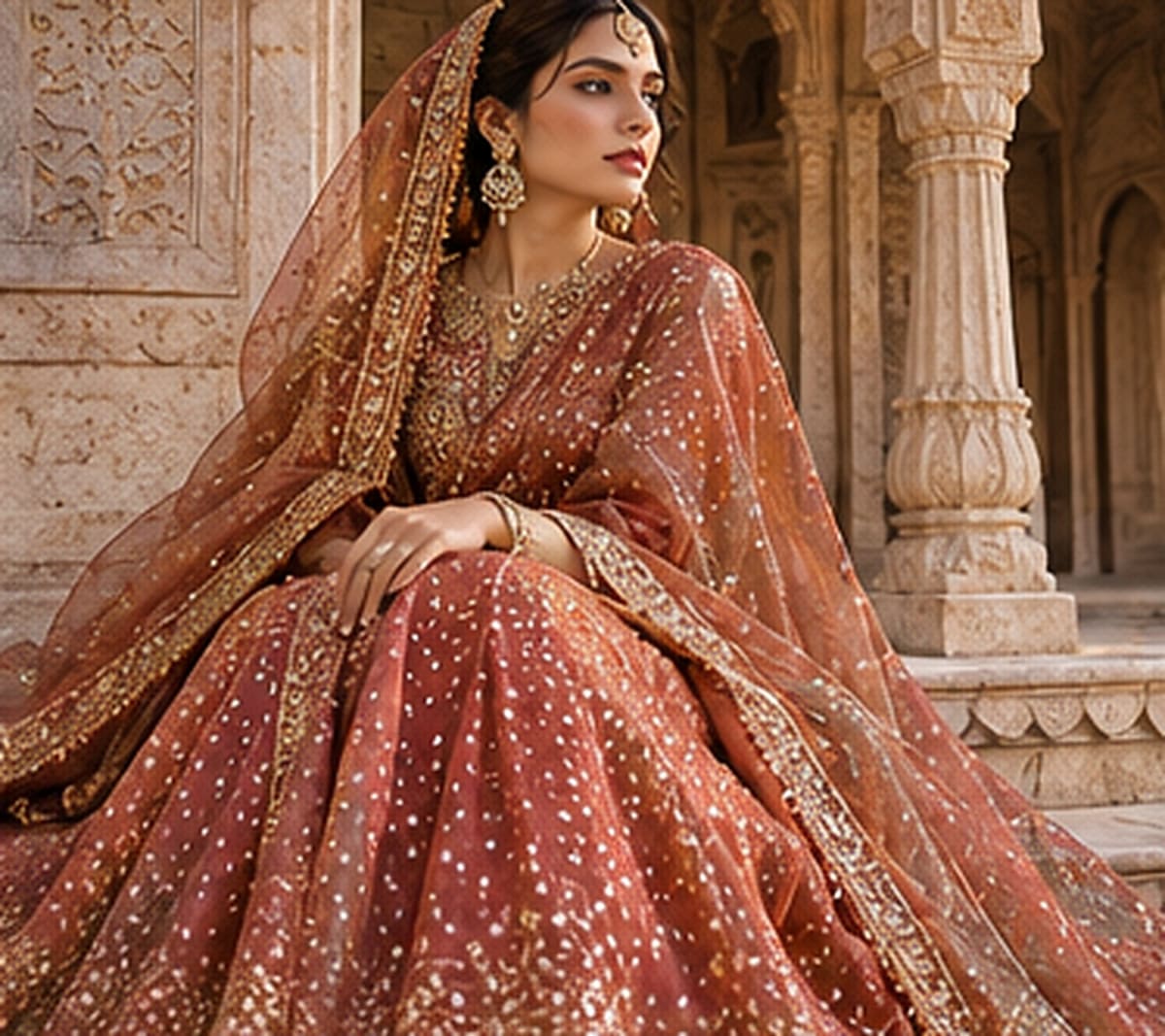
Think of a rust, terracotta, or deep maroon bridal ensemble whose surface glimmers with carefully spaced Mukaish instead of being covered entirely in dense decoration. A structured bodice can carry detailed floral elements, while a flowing lehenga or peshwas allows the small metallic accents to catch light as the wearer moves.
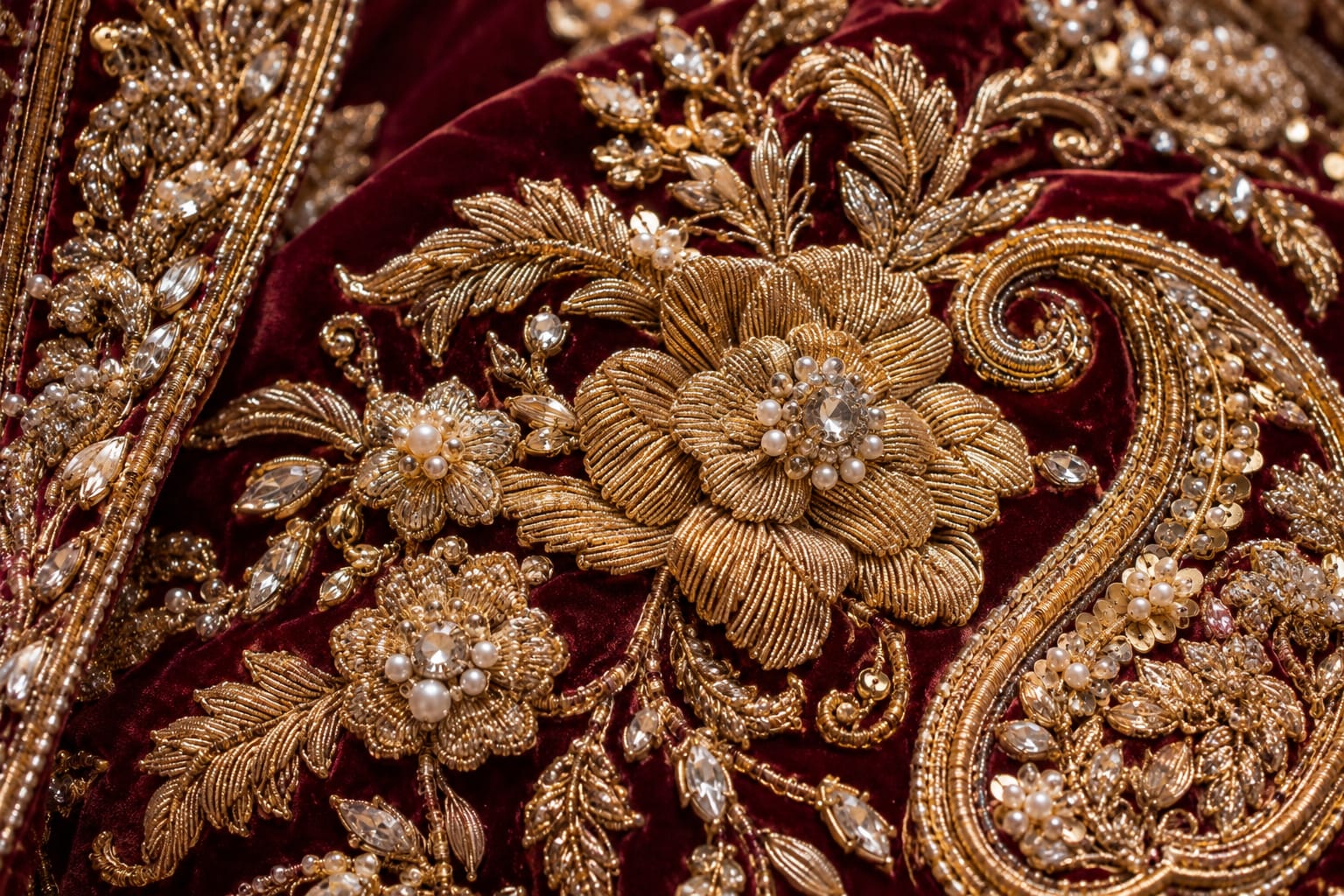
Mukaish and Kaamdani can also work as companions to zardozi, dabka, and naqshi. A garment may use those heavier techniques selectively at the neckline or hem and let finer metalwork provide light and softness elsewhere. The goal is not to make every inch shine equally; it is to guide the eye.
Terracotta bridal styling inspired by the richness of regional dress · AI-generated illustration
How these details fit into modern formal wear
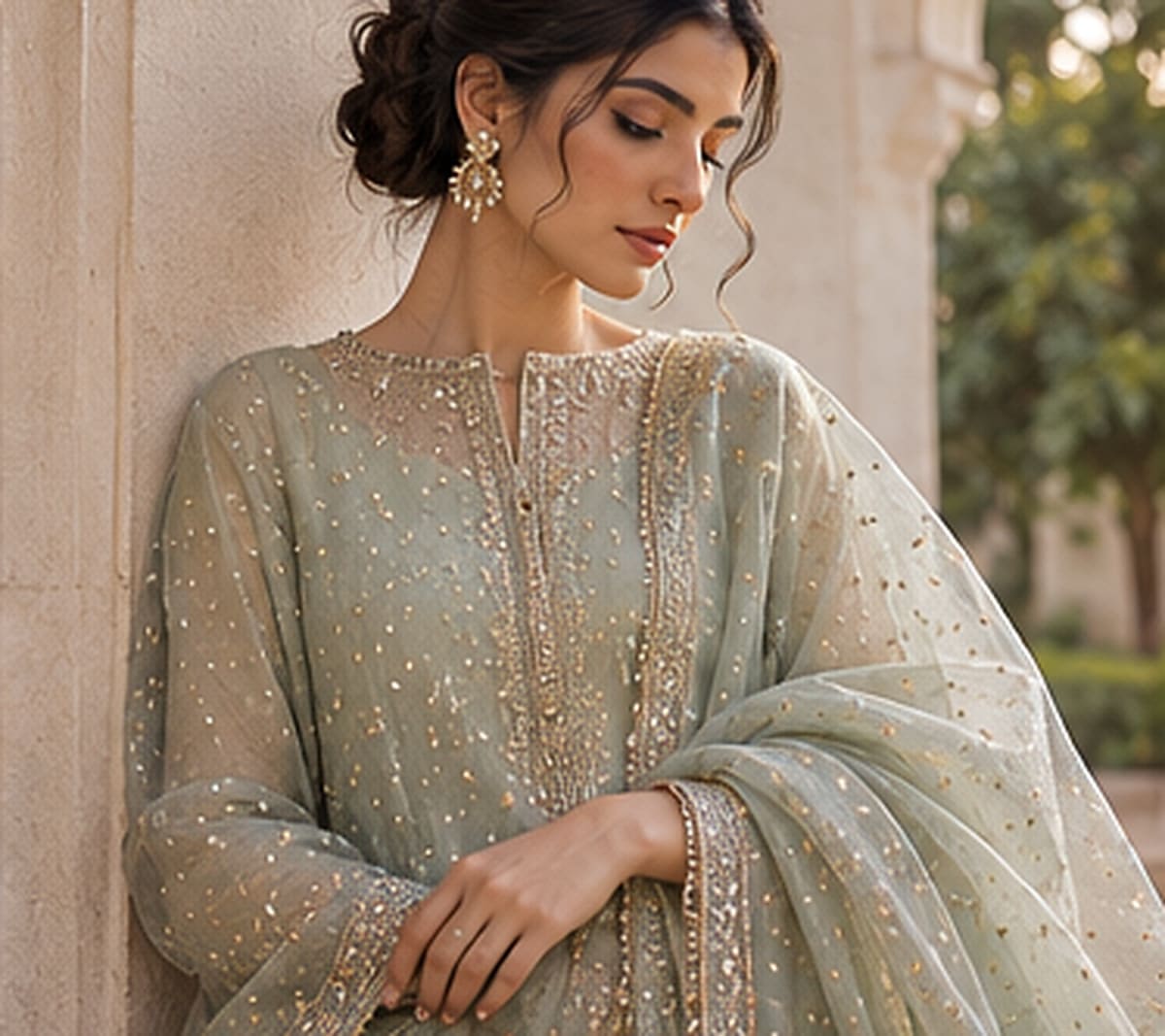
Traditional metallic embroidery does not have to be reserved for a bridal trousseau. A sage green formal, pastel kurta, softly draped sharara, or minimalist evening outfit can take on an entirely different character with a handful of thoughtfully placed metallic motifs.
The most versatile designs often use restraint: small fardi dots across the sleeves, a delicate floral border along a dupatta, or a light Kaamdani accent around the neckline. These choices feel contemporary precisely because the handwork is allowed to speak for itself.
Understated embroidery also suits contemporary formal silhouettes · AI-generated illustration
How to choose and care for a handcrafted piece
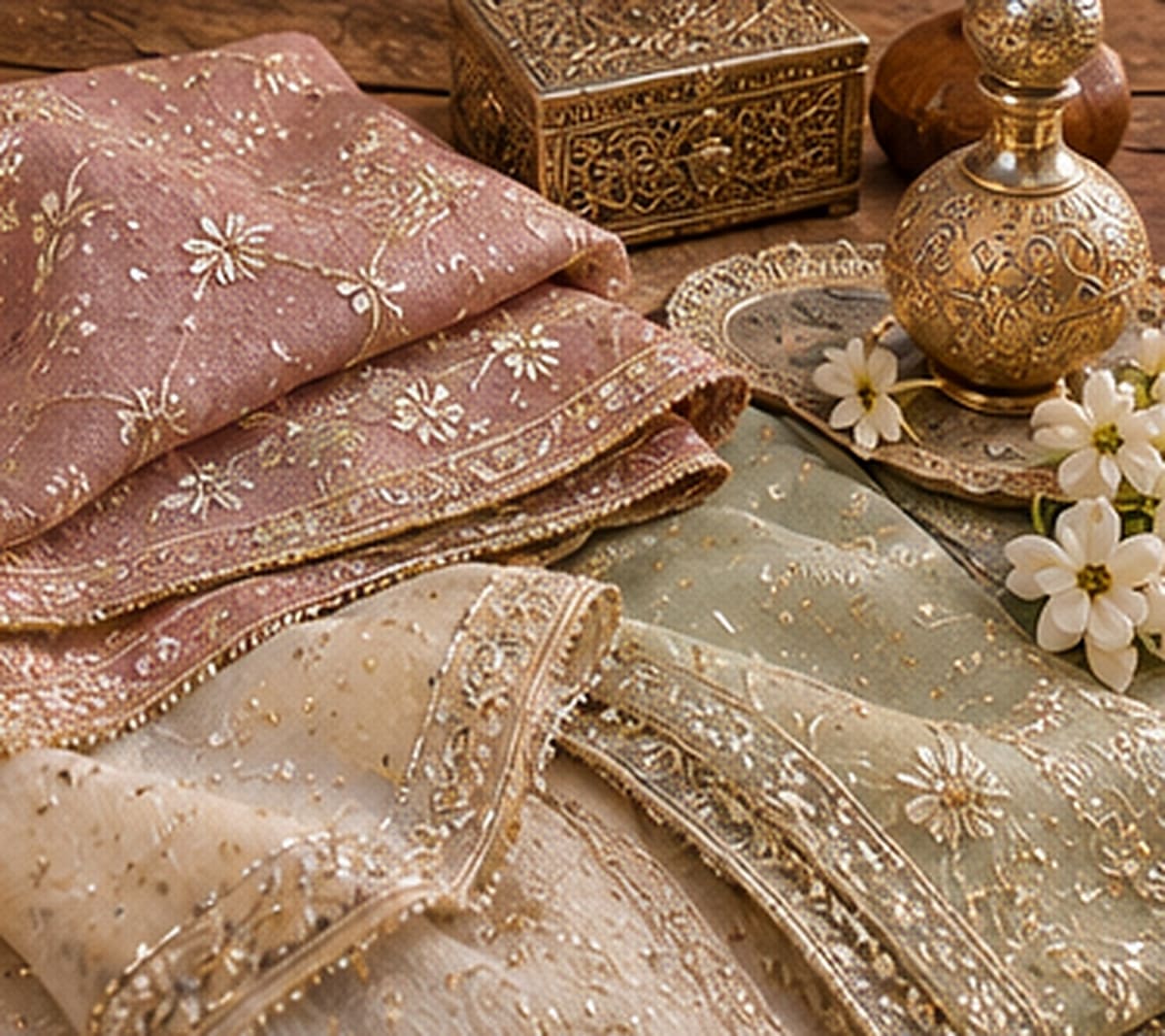
When commissioning or buying metallic handwork, ask what material is being used and whether the decoration is hand-applied. Request close-up photographs of the reverse side and a sample of the fabric, if possible. Discuss where the design will sit, how much density you want, and whether the finished weight is suitable for the garment.
For care, avoid rubbing metallic surfaces against rough jewellery or heavily textured bags. Store embellished pieces with soft, acid-free tissue between folds and keep them away from moisture. Do not press a hot iron directly onto metallic embroidery; use a specialist cleaner or the maker’s own garment-specific advice for cleaning, steaming, and pressing.
Precious textile details deserve mindful handling and preservation · AI-generated illustration
Reviving craft means valuing the hands behind it
When a hand-embellished textile is chosen with intention, it does more than complete an outfit. It keeps skilled workmanship visible in an industry that often rewards speed and imitation. Supporting fair artisan compensation, making time for detailed work, and explaining authentic techniques to customers are all meaningful ways to help the tradition continue.
In Bahawalpur, the documented presence of Mukesh work is a reminder that Pakistan’s regional craft stories deserve recognition alongside the better-known histories of Awadh. Preserving them begins with careful research, respect for artisans, and designs that carry the beauty of the past into today.
A timeless finish, a personal expression
Mukaish and Kaamdani prove that luxury does not always need to be loud. Sometimes, its finest expression is a soft constellation of metallic dots, a hand-worked floral vine, or a dupatta that moves like light.
At Nayyab, we celebrate the inspiration that traditional textile arts bring to individually considered bridal and formal designs. If you are exploring a bespoke outfit, begin with a conversation about fabric, colour, motif scale, and the kind of shimmer that feels most like you. The most memorable garment is one where heritage and personal style meet.
Have your outfit made for you
Tell us the colour, fabric and embroidery you're picturing. Our atelier in Bahawalpur makes it to your measurements, and we finalise every detail with you on WhatsApp.